
The Donora Public Library was founded in 1930. On January 30th of that year, a meeting of citizens took place representing 22 organizations interested in forming a public library. The meeting was sponsored by the Donora Women’s Club with Mrs. C.B. Charles presiding. The meeting was held at the Tri-Plant Club. The Donora Library Association was formed at this meeting, and donations of books were solicited from the community.
In 1940, William Donner, one of the founders of Donora, provided the library with its first annual gift of $100. The Donora Public Library was incorporated on October 18, 1943 and was housed at the Tri-Plant Club until 1946 when the collection was relocated to the Community Center Building.
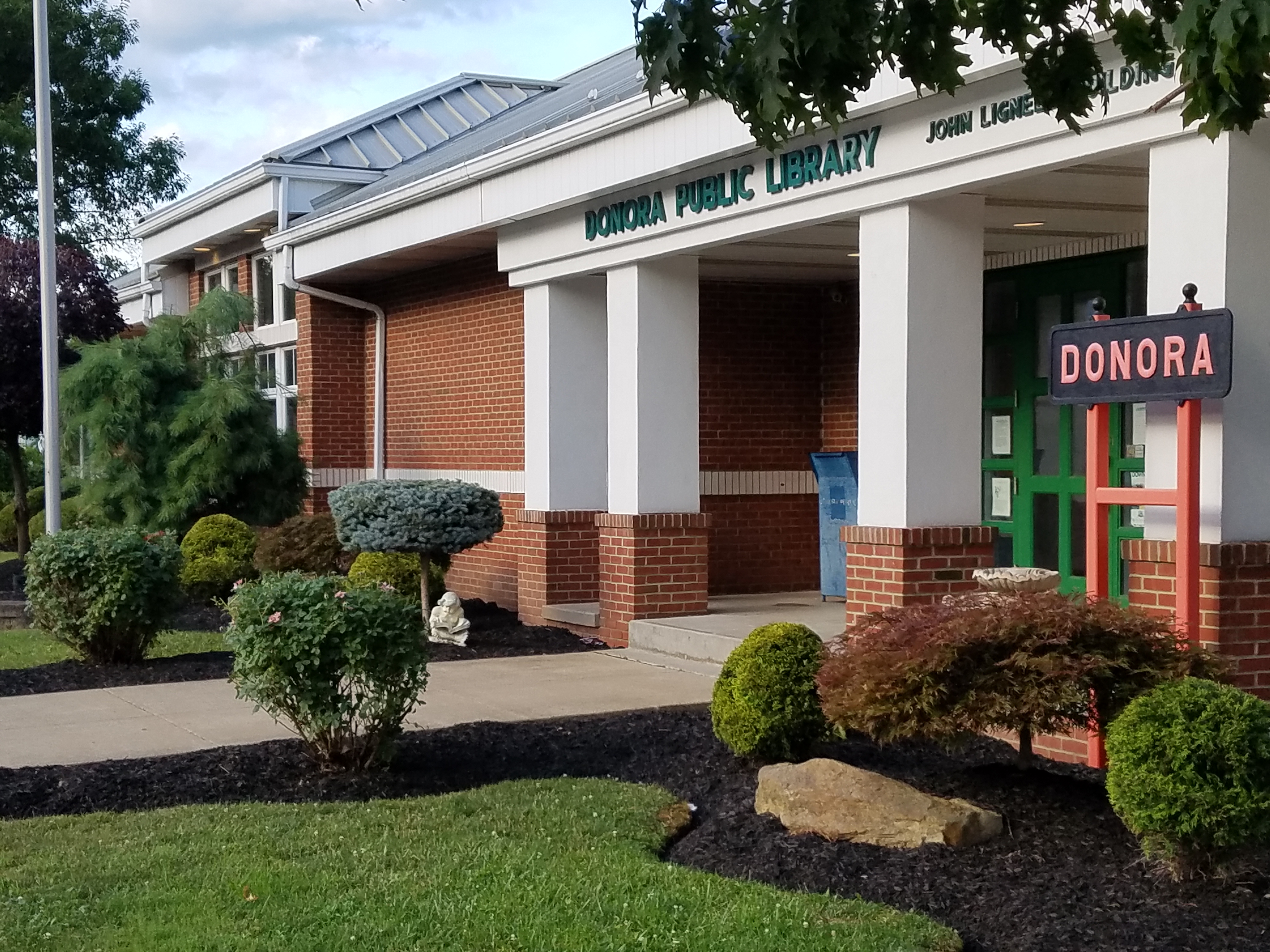
In 1995, ground was broken for a new home at 510 Meldon Avenue. The project was funded by a grant from the Commonwealth of Pennsylvania, and funds from the Donora Public Library Board of Directors, the Borough of Donora, the Redevelopment Authority of Washington County, Polycom-Huntsman Corporation, Friends of the Donora Community, and local fundraising campaigns. As we approach 100 years of service, we feel great pride and gratitude to those, both living and passed, whose gifts allow this library to be a treasure for generations to come.
The present facility was dedicated on October 26, 1996.
In the future, housing the Donora Historical Society and Donora Public Library in a state-of-the-art building will be a first step in reinventing the mid-Mon Valley from the center of the Rust Belt to a regional education center that embraces the past while looking at the future.
Original plans for reinventing the library called for a 40’x80′ attached wing, featuring a climate-controlled archive and exhibit space, study areas, and common event space. But since our acquisition of neighboring property, new concepts appropriate to Donora’s rich history and 21st-century literacy needs are being re-imagined.
The next stop on our growth adventure is to determine what kind of expansion is feasible and financially sustainable. Together with state and local agencies, private foundations, and your financial support, we can assure our area’s past will be available to future generations.